Weight Loss Smoothie That Actually Keeps You Full.
Most smoothies are dessert wearing a health halo.
Oat milk, a sweetened protein powder, a banana, a handful of berries, a drizzle of honey. Every ingredient sounds virtuous. Together they add up to a glass of sugar that spikes blood sugar, drops it ninety minutes later, and has the drinker hungry before eleven, wondering why something so healthy left them raiding the pantry.
A smoothie can absolutely support weight loss. It just has to be built as a meal instead of a snack pretending to be one. Here is the formula the Eat Shed Glow® method teaches, and that got featured in Woman's World.
What makes a smoothie good for weight loss?
A weight loss smoothie works when it holds you for four to five hours, the same as a real meal.
That comes down to four things working together: enough protein to protect muscle and keep hunger quiet, healthy fat to make it satisfying, fiber to slow sugar absorption, and little enough sugar that blood sugar stays steady instead of spiking and crashing.
Miss any one of those and the smoothie becomes a fast-digesting drink that empties the stomach quickly and starts the hunger clock all over again. That is the difference between a smoothie that supports weight loss and one that quietly works against it.
What goes in a weight loss smoothie?
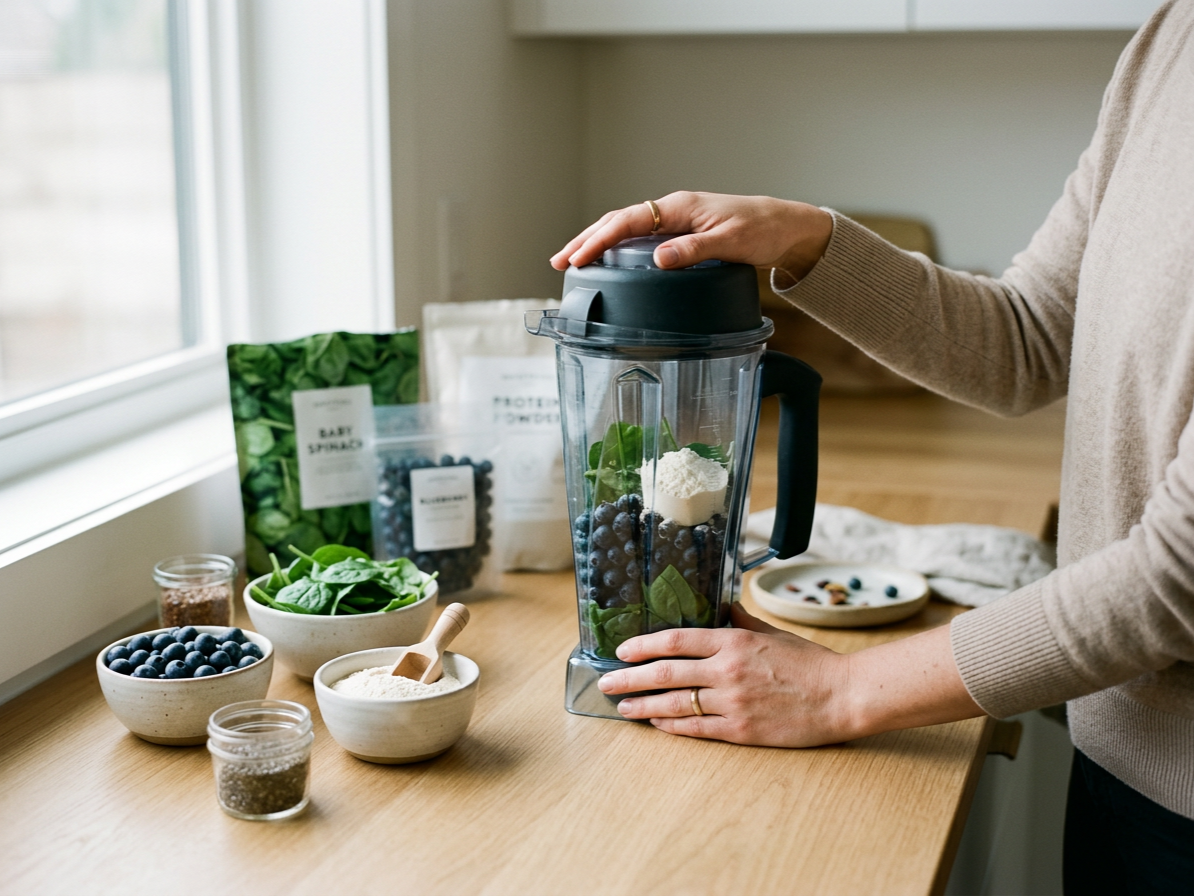
A balanced plate, blended. Six components, and the amounts matter more than the recipe.
Liquid base, 4 to 8 ounces. Unsweetened nut milk or water. Look for brands with short ingredient lists, like Malk or Elmhurst. Skip oat milk and fruit juice, which are sugar in liquid form. Use less liquid or add ice for a thicker texture.
Quality protein, enough to hit at least 30 grams. Grass-fed beef protein, organic pea protein, or grass-fed whey for anyone who tolerates dairy. Scoops range from 20 to 30 grams, so check the label and use however many gets to 30. Unsweetened, or sweetened with monk fruit or stevia leaf extract. Check out my favorite brands here.
Healthy fat, 1 tablespoon. Unsweetened nut butter, hemp hearts, MCT oil, or half a small avocado. This is the piece most people cut, and it is why they are hungry by ten.
Non-starchy vegetables, 1 to 2 cups. Spinach, kale, frozen zucchini, or frozen cauliflower. Frozen zucchini and cauliflower give a creamy texture without reaching for more fruit and the sugar that comes with it.
Fiber, 1 to 2 tablespoons. Chia, ground flaxseed, or both. They bring omega-3s alongside the fiber.
Frozen fruit, optional, a quarter to half a cup. Berries and tart cherries are lowest in sugar. Half a banana works, cut and frozen in advance.
What should you leave out of a weight loss smoothie?
The sugar nobody counts, because it arrives disguised as health food.
Oat milk has a glycemic index around 69, which lands it in the high category. Sweetened protein powders can carry as much sugar as a cookie. Fruit juice, honey, maple syrup, dates, and three kinds of fruit all compound into the same thing. None of it is evil. It is simply the whole reason the smoothie stops working.
If it needs to be sweeter, a few drops of pure monk fruit or stevia leaf extract does it without the spike.
Does a weight loss smoothie still work after 50?
It does, and the formula matters more in midlife, not less.
Three things change. Muscle stops responding to protein the way it used to, so the amount that worked at 35 no longer protects it, which is why research puts the target at 25 to 30 grams per meal at this stage and most people are eating half that. Digestion slows, so the fiber that worked at 30 rarely works at 50. And as estrogen falls, the same food raises blood sugar higher than it did ten years ago, and every spike is followed by a crash that asks for sugar.
That is the cycle this smoothie is built to interrupt. Protein supports muscle and bone at a stage when both become increasingly important. If this stage of life feels different from what worked before, read my guide to weight loss after 40, perimenopause and menopause.
The same protein target applies to anyone on a GLP-1, where protecting muscle while eating less is the whole game. More on that in the Eat Shed Glow® guide to GLP-1 nutrition.
What can you add to a weight loss smoothie?
Enhancements, chosen for what they do rather than what they trend as.
Creatine, 5g for strength, muscle, and brain function. The one worth adding for anyone in perimenopause or menopause, because estrogen decline affects all three, and it works hardest alongside strength training.
Collagen, 1 scoop for skin, hair, nails, and joints. On top of the protein, never instead of it, because collagen is not a complete protein.
Ceylon cinnamon, an eighth of a teaspoon, for blood sugar balance. Raw cacao, a tablespoon, for magnesium. Fresh ginger, a teaspoon, for digestion and bloating. Turmeric, a quarter teaspoon, for inflammation. Fresh basil or mint for flavor.
Espresso or matcha, one shot or one teaspoon, turns it into a frappuccino or a matchaccino worth drinking.
🤎
Want tips in your inbox? Sign up for The Monthly Newsletter. No BS, only the good stuff.