The Best Foods for Mood and Mental Health.
What you eat affects how you feel, and the mechanism is more specific than most food-and-mood articles suggest.
It is not that certain foods contain happiness. It is that your brain runs on what you feed it, your gut manufactures most of the chemistry involved, and your blood sugar decides how stable the whole system is hour to hour.
Here is what actually matters, and what to put on the plate.
Does food really affect your mood?
Yes, through three routes, and understanding them changes what you eat differently.
Your gut makes most of your serotonin. Around 90 to 95% of the body's serotonin is produced in the gut rather than the brain. Gut serotonin does not cross into the brain directly, but the gut and brain are in constant conversation through the vagus nerve and through compounds your gut bacteria produce. Feed those bacteria badly and the conversation changes.
Blood sugar drives how you feel hour to hour. When blood sugar crashes, your body releases adrenaline and cortisol to bring it back up. Those are stress hormones, and what they feel like is anxiety, irritability and shakiness. A lot of what people experience as a difficult afternoon is a blood sugar crash wearing an emotional costume.
Your brain needs raw materials. Omega-3 fats, B vitamins, magnesium, iron. Run short and mood, focus and energy all suffer, regardless of what is happening in your life.
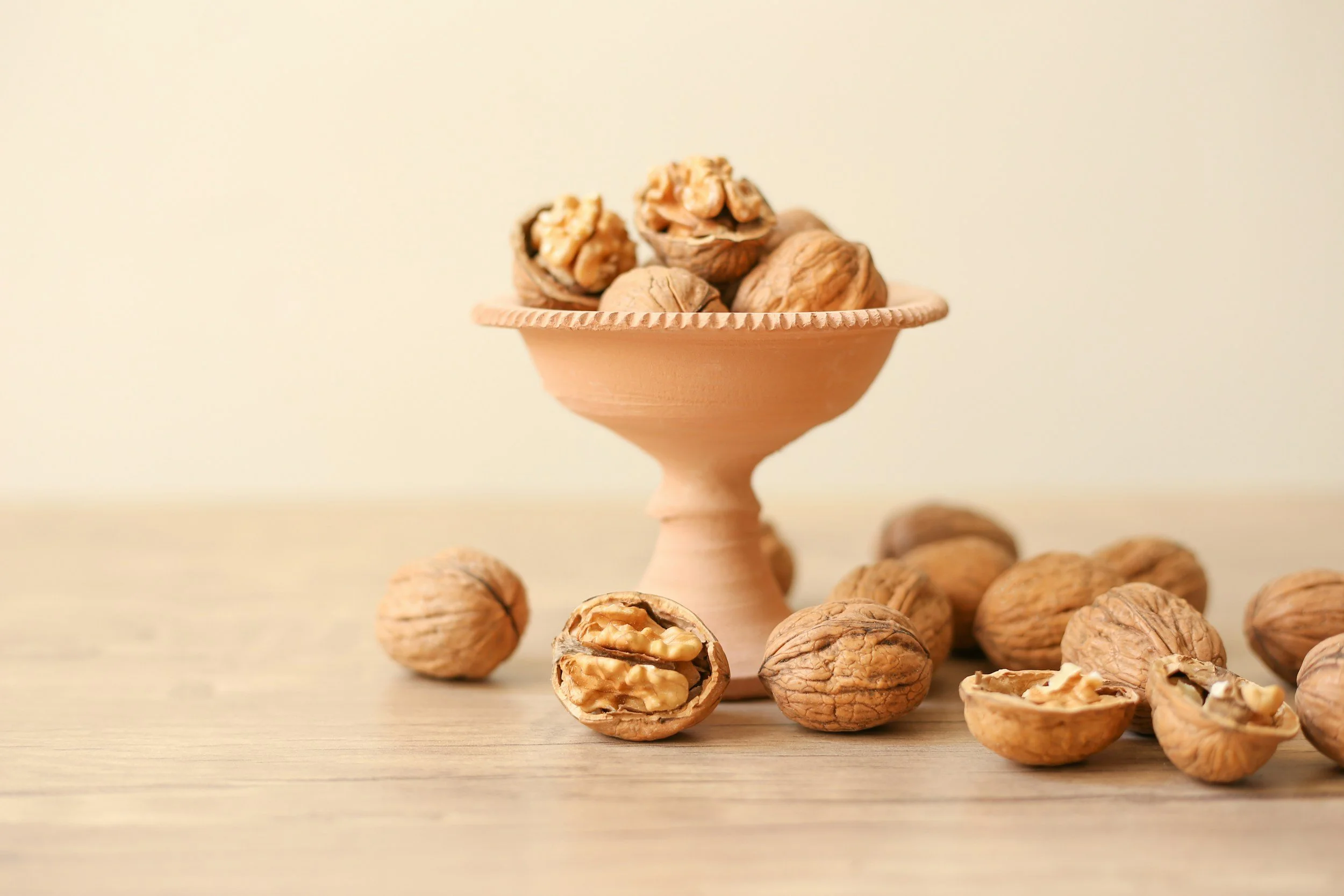
Walnuts
The highest omega-3 content of any nut, and worth being precise about why.
Walnuts provide ALA, a plant form of omega-3. Your body converts it into EPA and DHA, the forms your brain actually uses, but the conversion is inefficient, in the range of five to ten percent. So walnuts are genuinely good and they are not a replacement for oily fish.
If mood is what you are working on, sardines, salmon and mackerel do more, because they supply EPA and DHA directly. Walnuts are the excellent everyday addition rather than the whole answer.
A handful with breakfast, in a salad, or on yogurt.
Berries
Deeply pigmented berries carry anthocyanins, the compounds responsible for the colour, and those are among the better-studied polyphenols for brain health.
They are also one of the few genuinely sweet things with enough fiber to avoid a spike, which makes them the rare snack that satisfies a sugar craving without creating the crash that follows.
Blueberries, blackberries and strawberries. Frozen works and often costs less.
Leafy greens
Spinach, kale and chard are rich in folate, a B vitamin involved in producing the neurotransmitters that regulate mood. Low folate is consistently associated with low mood.
They also carry magnesium, which is involved in the stress response and which a great many people are short on.
The practical version: a handful of spinach into eggs, a soup or a smoothie takes ten seconds and you do not taste it.
Eggs
The most complete food on this list, and worth being accurate about.
Eggs contain tryptophan, which is the precursor to serotonin. But eating tryptophan does not straightforwardly raise brain serotonin, because it has to compete with other amino acids to get across the blood-brain barrier. Anyone telling you eggs make serotonin is skipping several steps.
What eggs genuinely do is better than that story. They are one of the best sources of choline, which your body uses to make acetylcholine, the neurotransmitter involved in memory and focus. Most people do not get enough. And three eggs give you around 19 grams of complete protein, which is the thing that actually holds your blood sugar steady through a morning.
Steady blood sugar is worth more to your mood than any single nutrient on this page.
Dark chocolate
Genuinely good, for reasons that are not the ones usually given.
Dark chocolate at 70% or higher is rich in flavanols, which support blood flow to the brain, and it is a meaningful source of magnesium. What it does not do is deliver serotonin, and the tryptophan content is too small to matter.
The other part is real though, and worth saying: enjoying something you like, slowly, without guilt, does something for your mood that no nutrient chart captures. That is not a loophole. That is the point.
Two or three squares. These are happy calories.
Fermented foods
The one most missing from lists like this.
Yogurt with live cultures, kefir, sauerkraut, kimchi and miso feed the gut bacteria that produce the compounds involved in that gut-brain conversation. Given how much of your serotonin is made down there, what you feed those bacteria is not a side issue.
Alongside them, fiber. Vegetables, beans, oats, berries. Your gut bacteria eat fiber, and no probiotic makes up for not feeding them.
What matters more than any single food
Not skipping meals.
You can eat every food on this list and still feel terrible if you run on coffee until 2pm and then crash. The steadiest thing you can do for your mood is eat regularly, with protein at every meal, so your blood sugar never falls far enough to trigger the stress response.
That is what strategic snacking is really for, and it is why enough protein does more for how you feel than any superfood.
And it is worth saying plainly: food supports mental health, it does not treat mental illness. If you are struggling, this is the thing that sits alongside proper support, not instead of it.
How you eat matters too
Not just what.
Eating standing up, between calls, in four minutes, is a different physiological event from sitting down for fifteen. Your body digests better when it is not braced, and you register fullness far more reliably.
Slow down enough to notice what you are eating. It is the cheapest intervention on this page and the one almost nobody does.
And if this is the part that keeps slipping, that you know what to eat but the day gets away from you, that is exactly what the Eat Shed Glow® method is built to fix. Not another list of good foods. A way of eating designed around your actual life, so steady blood sugar and a calmer head stop being something you have to remember.
🤎
Want tips in your inbox? Sign up for The Monthly Newsletter. No BS, only the good stuff.