Your Gut Bacteria Might Be Driving Your Cravings.
You have somewhere around a hundred trillion bacteria living in your large intestine, and they are not passive.
They break down food you cannot digest, produce compounds that affect your immune system, and talk to your brain continuously through a nerve that runs from your gut to your brainstem.
Which raises a genuinely unsettling question. When you want something sweet at 4pm, whose idea is that?
I was asked about this recently for Delish, on the best foods for gut health. It is one of the most interesting areas in nutrition right now, and one of the most overstated, so it is worth separating what we know from what gets sold.
Can gut bacteria actually cause cravings?
In mice, clearly yes. In humans, probably, and the honest answer is that we are still working it out.
The mouse evidence is striking. Transplant gut bacteria from a mouse that prefers sugar into a different mouse, and the recipient starts preferring sugar too. Same animal, same brain, different bacteria, different food choices.
Human research is harder, because you cannot control what people eat for months or swap their microbiomes. What we have is observational: people with different bacterial profiles show different craving patterns. Suggestive rather than conclusive.
So the honest position is that gut bacteria influence appetite and food preference, the mechanism is well described, and the size of the effect in humans is not yet pinned down. Anyone telling you your microbiome definitely controls your cravings is ahead of the evidence.
How would bacteria even do that?
Through the vagus nerve, which is the direct line between your gut and your brain.
Your gut contains its own nervous system, sometimes called the second brain, with more neurons than your spinal cord. The vagus nerve connects it to your brainstem, and traffic runs in both directions constantly.
Bacteria participate in that conversation. They produce compounds that influence the signals your gut sends upward, including molecules that act on the same pathways involved in reward and motivation. Some also produce short-chain fatty acids like butyrate, which fuels the cells lining your gut and quiets inflammatory signalling.
The logic is uncomfortable and simple. Different bacteria eat different things. Bacteria that thrive on sugar do better when you eat sugar. They have every reason to make that outcome more likely, and a communication channel to your brain to do it with.
The loop that keeps it going
This is the part that matters practically, because it is where you can intervene.
Eat a lot of sugar and refined carbohydrate, and you feed the bacteria that thrive on it. They multiply. The ones that prefer fiber get crowded out. The balance shifts toward a population that does better when you keep eating the same way.
Then the cravings feel stronger, which is not imagination and is not weakness.
The good news is that it runs the other way too. Change what you feed them and the population changes, and it happens faster than most people expect. Meaningful shifts show up within days of a real dietary change.
You have probably felt this without having a name for it. Eat well for two weeks and the pull toward sugar quietly fades, and food you used to want stops appealing. Then a bad weekend, and by Tuesday the craving is back at full volume.
That is not your willpower returning and then deserting you. It is a population changing, and then changing back. Which is oddly reassuring, because a population is something you can feed differently starting at the next meal.
What actually feeds the good bacteria?
Fiber, in variety. That is the whole answer, and it is duller than the supplement aisle would like.
Your bacteria cannot eat protein or fat in any meaningful way. They eat the parts of plants you cannot digest, and different species prefer different kinds, which is why variety beats volume. Thirty different plants a week does more than a large quantity of one.
Beans, lentils and chickpeas are the strongest single category.
Vegetables, particularly onions, garlic, leeks and asparagus, which carry the specific fibers bacteria favour.
Berries and other fruit with the skin on.
Oats, and whole grains that still have their fiber.
Nuts and seeds.
More on why fiber matters this much in is fibermaxxing worth it.
The cooking trick worth knowing
Cook your grains, let them cool completely, then reheat them.
When rice, potatoes or pasta cool, some of the starch reorganises into a form your body cannot digest. It is called resistant starch, and it behaves like fiber, travelling to your large intestine intact and feeding the bacteria there. Reheating does not undo it.
So yesterday's rice is genuinely better for your gut than today's, and it is the rare piece of nutrition advice that costs nothing and requires no shopping.
Fermented foods, and where they actually help
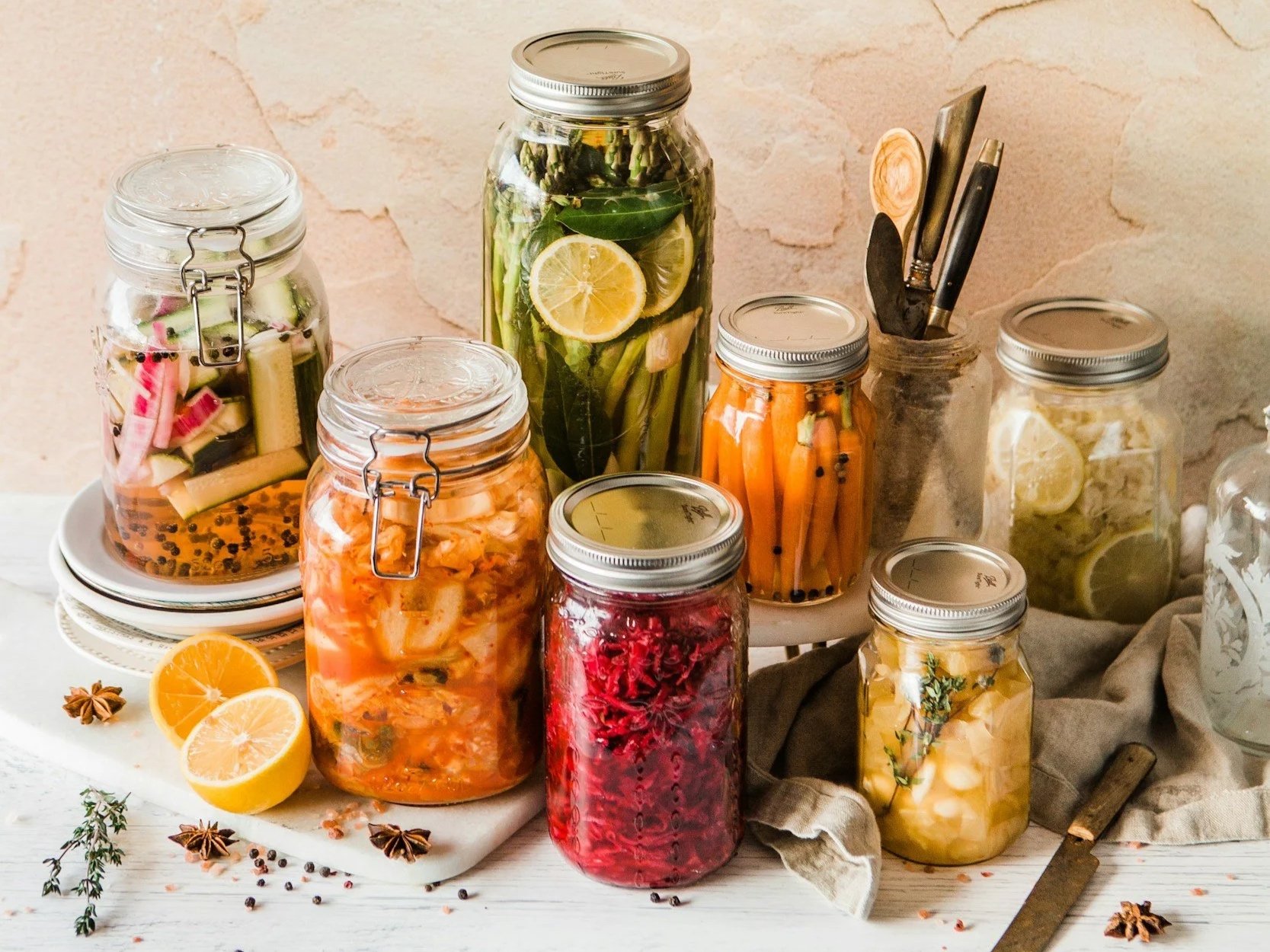
Yogurt with live cultures, kefir, sauerkraut, kimchi, miso.
These add bacteria rather than feeding the ones you have, and both matter. But the order does. Adding bacteria to a gut with nothing to eat is like introducing tenants to an empty fridge. Fiber first, fermented foods alongside.
What this does not mean
That your cravings are entirely your microbiome's fault, or that a probiotic fixes them.
By far the most common cause of a 4pm craving is still blood sugar. You ate lunch with no protein in it, your blood sugar spiked and crashed, and your body wants fast fuel. That mechanism is well established, immediate, and fixable at the next meal.
The microbiome sits underneath as a slower, quieter influence. Worth attending to, and not the first place to look. More on what your cravings are really telling you.
Where to start
Eat more plants, and more different ones.
Add beans to something you already make. Buy the berries. Cook the rice the day before. Get a fermented food into your week.
Then fix the thing above it, which is enough protein at every meal so blood sugar stays steady and the craving never arrives in the first place.
Your gut bacteria are not the enemy. They are responding to what you send down. Send different things and the conversation changes. And if you’re tired of turning every nutrition headline into another food rule, start with my guide to weight loss without dieting.
🤎
Want tips in your inbox? Sign up for The Monthly Newsletter. No BS, only the good stuff.