What to Eat on GLP-1 Medications.
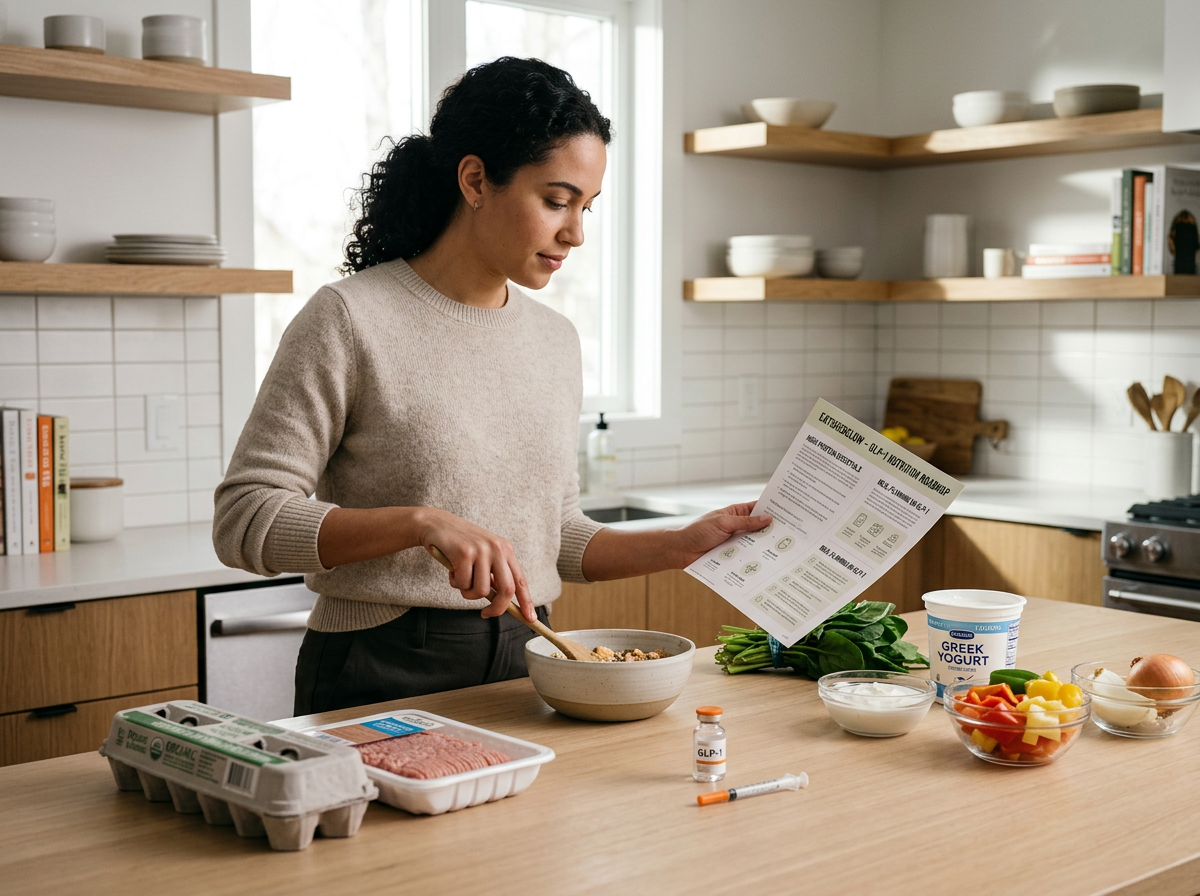
The prescription arrives with a dose schedule, a list of side effects, and almost nothing about food.
That gap is where the trouble starts. The medication quiets the food noise. It does not teach you what to put on the plate once the noise goes quiet, and that is the part that decides whether the weight stays off.
This is the guide the prescription did not come with.
What do GLP-1 medications actually do?
They mimic a hormone your body already makes, at much higher levels than you produce on your own. That hormone signals fullness, slows how fast your stomach empties, and helps steady blood sugar.
The active ingredients are semaglutide, sold as Ozempic and Wegovy, and tirzepatide, sold as Mounjaro and Zepbound. You will see the same compounds sold as compounded semaglutide and compounded tirzepatide. GLP-1s are one category within a larger field of peptides being studied for weight loss, though GLP-1s carry by far the most research behind them.
The result is dramatic. Appetite drops, cravings fade, and weight loss stops feeling like a fight against hunger. These medications work, and the clinical results are real.
What they do not do is teach your body what to eat. That is the half of the equation that decides whether your results hold.
Do you lose muscle on Ozempic or Wegovy?
Some of what comes off is lean mass, but fat loss dominates, and body composition usually improves overall.
The numbers get reported badly, so here is the honest version. In the body composition substudy of the semaglutide trials, participants lost roughly 19% of total fat mass and roughly 10% of total lean body mass. Lean mass as a proportion of total body weight actually went up by about three percentage points. In practice, somewhere between a third and 40% of the weight lost was lean tissue, and the rest was fat. Tirzepatide data puts the lean share closer to a quarter.
Two things matter here.
Lean mass is not the same as muscle. A DXA scan counts muscle, organs, and body water together. Some of that early drop is water and glycogen, not muscle fiber.
The ratio is not fixed. Rapid loss with low protein is what drives lean tissue down. Adequate protein and resistance work change it substantially, with or without a medication involved.
Why it matters beyond the mirror: muscle drives long-term metabolism. Adults naturally lose roughly 3 to 8% of muscle per decade after 30, and rapid weight loss can compress that into months. Protect it now and maintenance gets far easier later.
What nutrients are easiest to miss on a GLP-1?
Fiber, iron, B12, magnesium, and calcium, because smaller meals mean less of everything.
The symptoms show up before anyone connects them to food. Fatigue that sleep does not fix. Hair shedding a few months in. Brain fog. Getting sick more often. Constipation that will not resolve.
Practical coverage without adding volume: chia and ground flax for fiber, red meat or sardines with a source of vitamin C for iron, eggs and dairy for B12, pumpkin seeds and leafy greens for magnesium, dairy or sardines with bones for calcium.
Anything beyond food, including whether a supplement is warranted, is a conversation for a doctor who can run bloodwork. Deficiencies get diagnosed with labs, not guesswork.
The protein sources, electrolytes, and fiber support I recommend for GLP-1 users are in Coco's Picks: GLP-1 Support. Some links are affiliate links, which means I may earn a commission at no additional cost to you.
How much protein do you need on a GLP-1?
Aim for at least 30 grams of protein per meal, three meals a day, from real food. Across the day that is roughly 0.7 to 1 gram per pound of body weight, which lands most adults between 100 and 150 grams once you count your snacks.
That looks like three eggs plus a slice of cheese, five ounces of chicken or salmon, a cup of Greek yogurt with seeds, a cup of cottage cheese, or a firm tofu portion the size of a deck and a half of cards.
When appetite is suppressed, protein has to be the first thing on the plate rather than the afterthought. If you can only manage half a meal, the half you eat should be the protein. Everything else is negotiable in a way protein is not.
One clarification I hold firmly: beans and lentils are not the protein anchor. They are complex carbohydrates with some protein attached. They belong on the plate. They do not do the job eggs, fish, poultry, dairy, or meat do. The full breakdown is here: how much protein you actually need.
What should a plate look like on a GLP-1?
Build it visually, in this order: protein first, then vegetables, then complex carbohydrates, then healthy fats.
Protein: palm-sized portion, every meal, no exceptions
Non-starchy vegetables: roughly half the plate by volume
Complex carbohydrates: a cupped handful, like quinoa, sweet potato, oats, or sourdough
Healthy fats: a thumb-sized amount, olive oil, avocado, nuts, seeds
No counting, no apps, no weighing. The plate is the measuring tool, and it works at home, at a restaurant, and in an airport.
When your stomach can only hold a small volume, every bite has to earn its place. That is the entire argument for building the plate this way rather than eating whatever seems tolerable that day.
Should you snack on a GLP-1?
Yes. Two strategic snacks a day, even small ones, even when hunger never shows up.
The instinct on a GLP-1 is to skip eating entirely, because nothing sounds appealing. That instinct works against you. Long gaps with almost no protein are exactly the conditions that pull lean tissue down and leave energy flat.
A strategic snack pairs protein with fiber or healthy fat. Greek yogurt with berries. Two hard-boiled eggs. Cottage cheese with pumpkin seeds. Turkey slices and cucumber. Small and consistent beats large and occasional.
How much water do you need on a GLP-1?
At least 80 ounces a day, and more with heat, exercise, or alcohol.
These medications slow digestion, and dehydration makes almost every common side effect worse. Nausea gets sharper. Constipation gets stubborn. Fatigue and headaches arrive and get blamed on the medication when the real cause is a water deficit.
Dehydration also raises stress hormones and quietly stalls progress in ways that have nothing to do with the medication. More on that in why dehydration stalls weight loss. Add electrolytes if your intake has dropped sharply, because when food volume falls, sodium, potassium, and magnesium fall with it.
How do you manage nausea and constipation with food?
Smaller volume, lighter on fats at that meal, slower eating, and enough fluid.
For nausea: eat less at a sitting and more often. Go lighter on healthy fats when nausea is active, since fat slows stomach emptying further and the medication is already doing that. Cold or room-temperature foods are often easier than hot ones. Stop at the first sign of fullness rather than pushing to finish.
For constipation: fiber and fluid together, since fiber without water makes it worse. Add a daily walk. Magnesium helps many people, and that is worth raising with your prescriber rather than self-managing.
If side effects are severe, persistent, or worsening, that is a medical conversation, not a nutrition one.
What happens to your weight when you stop?
Appetite returns, and without new habits in place, most of the weight can follow.
Trial data showed people who came off semaglutide regained about two-thirds of what they had lost within a year. Newer real-world data complicates that usefully: across tens of thousands of patients, outcomes split roughly three ways, with some regaining, some holding, and some continuing to lose.
That split is the whole story, and here is the reframe that changes outcomes. The medication opens a window of quiet. Appetite is low, cravings are manageable, food noise has stopped. That window is the easiest time you will ever have to learn how to eat, because the usual resistance is not there.
Most people spend the window losing weight. The ones who keep it off spend the window learning.
Every meal you eat on the medication should be one that still works without it. A protein shake and not much else collapses the moment appetite comes back. Balanced plates, protein at every meal, and two strategic snacks holds. The full transition plan is here: how to keep the weight off after stopping Ozempic and Wegovy.
Does any of this change after 40?
Yes. Perimenopause and menopause shift how your body handles protein, blood sugar, and muscle.
Estrogen decline reduces how efficiently muscle is built and maintained, which raises your protein requirement at exactly the moment appetite is being suppressed. Sleep disruption and higher stress hormones add friction that is not there at 30, and the medication does not account for any of it.
The practical shift is toward the upper end of the protein range, resistance work as a non-negotiable, and more attention to sleep and stress than a younger body would need.
GLP-1 nutrition FAQs
How many grams of protein per day on a GLP-1?
Roughly 0.7 to 1 gram per pound of body weight, which lands most adults between 100 and 150 grams a day. Build it from at least 30 grams at each of three meals plus protein at both snacks.
Can you eat carbs on a GLP-1?
Yes. Complex carbohydrates support energy, fiber intake, and sleep. The Eat Shed Glow® method never removes a food group. Carbs go on the plate after protein and vegetables, in a cupped-handful portion.
Is it normal to have no appetite at all?
It is common, especially after a dose increase. Eating still needs to happen on a schedule rather than on hunger cues, because hunger is not a reliable signal while the medication is working. Persistent inability to eat is worth reporting to your doctor.
Do you need protein shakes on a GLP-1?
No, though they help when appetite is low and chewing a full meal feels impossible. Real food should be the foundation, with shakes filling gaps rather than replacing meals long term.
Will you lose your hair on a GLP-1?
Shedding a few months into rapid weight loss is common and usually temporary. It is typically driven by the speed of the loss combined with low protein and low iron, which is why both intake and bloodwork matter.
Should you drink alcohol on a GLP-1?
Many people find their tolerance drops sharply and their interest fades. Alcohol also pauses fat burning while your body processes it. Worth raising with your prescriber.
Can you keep the weight off after stopping?
Yes, and it depends almost entirely on what got built during the months on the medication.
Eat Shed Glow® for GLP-1 nutrition
Diets hand people rules. Understanding is what you can carry with you. The Eat Shed Glow® GLP-1 Nutrition Coaching & Accountability program is personalized 1:1 nutrition support for any stage of your GLP-1 journey, whether you’re taking Ozempic, Wegovy, Mounjaro or Zepbound. You’ll learn how to eat as your appetite changes, support your nutrition and muscle, and build the skills you’ll need for the long term, on the medication or beyond it.
🤎
Want tips in your inbox? Sign up for The Monthly Newsletter. No BS, only the good stuff.